"Well, somebody had to go punk, right? In 1983's 'The Punk,' a mohawked Jughead puts an iron chain around his neck and demands to be called 'Captain Thrash,' but just when Archie's ready to save his pal from his 'convention for weirdos,' Betty reveals that Jughead's only doing undercover work for the school paper. Whew!"
The Onion's A.V. Club surfs twentieth-century trends via Archie Comics.
Monday, August 14, 2006


Sunday, August 13, 2006
Apollo or Dionysius?
From the Slate achives, Jacob Weisberg uses a Matisse and Picasso exhibit in 1999 to revive Nietzsche's binary division of art. Weisberg also adds suggestions from readers.
Saturday, August 12, 2006
Brazilification
"Los Angeles County 'has more billionaires than any other part of the country. It's also the capital of the working poor,' said Peter Dreier, chairman of the Urban and Environmental Policy Program at Occidental College.
"That wasn't always the case. A generation ago, the region was a model for the post-World War II, middle-class lifestyle. High-wage manufacturing jobs were abundant, particularly in the aerospace industry. When the industry collapsed in the early 1990s, many middle-class residents left the region. In the meantime, large numbers of immigrants arrived seeking work."
A new demographic study names LA "the most economically segregated region in the country," as reported by the Los Angeles Times.
"That wasn't always the case. A generation ago, the region was a model for the post-World War II, middle-class lifestyle. High-wage manufacturing jobs were abundant, particularly in the aerospace industry. When the industry collapsed in the early 1990s, many middle-class residents left the region. In the meantime, large numbers of immigrants arrived seeking work."
A new demographic study names LA "the most economically segregated region in the country," as reported by the Los Angeles Times.
"Organize to Mourn"
"He argues that this obsession with the past stifles radical politics. 'As a form of politics, of people mobilising in an effort to achieve or get things done, you have to ask if this is the right way. It seems inhospitable to serious change in the present--to resolving material inequality for example. It doesn’t seem promising.' It can also breed fragmentation in the place of solidarity. 'It cultivates a certain kind of identity politics, pitting groups against each other, when joining forces would be better. My impulse is that we need a universal politics which help all the poor.'"
Tiffany Jenkins in Spiked interviews CUNY's John Torpey, author of Making Whole What Has Been Smashed: On Reparations Politics.
Tiffany Jenkins in Spiked interviews CUNY's John Torpey, author of Making Whole What Has Been Smashed: On Reparations Politics.
Friday, August 11, 2006
History of Rock Written by the Losers
"Although rock historians provide a valuable service to music fanatics, Princeton sociology professor Henry Yates said that their focus on music hinders their accumulation of knowledge in other areas.
"'From discussing long-defunct record labels to analyzing the impact of a band's personnel changes, rock historians cannot see beyond their acne-scarred noses to realize that there are interesting subjects in the world besides music,' said Yates, a self-professed 'ex-music-nerd.' 'If you ask them who the U.S. attorney general is, or what's going on in the park around the corner, you'll get a blank stare. But ask which member of The Doors produced Los Angeles, the debut album by X, and you'll have to dodge all the flying spittle from everyone trying to be the first to answer.'
"Added Yates: 'It was Ray Manzarek.'"
From The Onion.
"'From discussing long-defunct record labels to analyzing the impact of a band's personnel changes, rock historians cannot see beyond their acne-scarred noses to realize that there are interesting subjects in the world besides music,' said Yates, a self-professed 'ex-music-nerd.' 'If you ask them who the U.S. attorney general is, or what's going on in the park around the corner, you'll get a blank stare. But ask which member of The Doors produced Los Angeles, the debut album by X, and you'll have to dodge all the flying spittle from everyone trying to be the first to answer.'
"Added Yates: 'It was Ray Manzarek.'"
From The Onion.
Thursday, August 10, 2006
To Your Health
"The folks who wag warning fingers over the dangers of trans fats, and hail the benefits of leafy greens, are silent on alcohol. These public health messengers — who remind us to quit smoking, eat fresh fruits and vegetables and exercise every day — are not about to tell people to start drinking.
"Their reluctance comes even amid growing evidence that moderate drinking is beneficial. A study last week in the Archives of Internal Medicine showed that light to moderate alcohol consumption in people age 70 to 79 is associated with significantly lower rates of cardiac events and longer survival. A week earlier, researchers reported in the July 18 issue of the Journal of the American College of Cardiology that moderate alcohol consumption may help ward off development of heart failure."
The Los Angeles Times investigates the importantance of the daily pint.
"Their reluctance comes even amid growing evidence that moderate drinking is beneficial. A study last week in the Archives of Internal Medicine showed that light to moderate alcohol consumption in people age 70 to 79 is associated with significantly lower rates of cardiac events and longer survival. A week earlier, researchers reported in the July 18 issue of the Journal of the American College of Cardiology that moderate alcohol consumption may help ward off development of heart failure."
The Los Angeles Times investigates the importantance of the daily pint.
Wednesday, August 09, 2006
Go Bears
"As we said last year, imagine if colleges--the many thousands of them--tried to boost their scores on The Washington Monthly College Rankings. They'd enroll more low-income students and try to make sure they graduated. They'd encourage their students to join the military or the Peace Corps. And they'd produce more scientists and engineers. In short, our country would grow more democratic, equitable, and prosperous."
Washington Monthly unveils its alternative list of top colleges for 2006, with UC Berkeley named as the leading public university.
Washington Monthly unveils its alternative list of top colleges for 2006, with UC Berkeley named as the leading public university.
Tuesday, August 08, 2006
Mission Accomplished
"Still, the Franciscans remained good record-keepers. They assigned numbers to each baptism and carefully noted parents and godparents, village of origin, ethnic background and trades. As a result, many people can be traced with astonishing specifics through life and, with computer links, their progeny."
The Los Angeles Times reports on the Early California Population Project, an online database created by the Huntington Library to document California's population history from 1769 to 1850.
The Los Angeles Times reports on the Early California Population Project, an online database created by the Huntington Library to document California's population history from 1769 to 1850.
Monday, August 07, 2006
Quality You Can Taste
"Many credit the Snyders with introducing California's first drive-through restaurant. At the very least, the Snyders made the innovation so popular and practical that other fast-food establishments soon followed their lead.
"For more than half a century, the chain has stuck to its basic menu of cooked-to-order hamburgers made with 100% beef, hand-torn lettuce and slow-rising, freshly baked buns; French fries made from California-grown Kennebec potatoes, hand-cut and fried in cholesterol-free vegetable oil; and milkshakes made with real ice cream. There are no kids' meals, no breakfast items, no chicken strips or nuggets, no salad bars and no franchises—the restaurants are all owned by the company. And the stores are still open until 1 a.m. or later."
The Los Angeles Times runs an obit for Esther Snyder, co-founder of In-N-Out Burger.
"We don't do a good job commemorating the innovative fast-food chains that Southern California has unleashed on the world. Carl's Jr. launched from Anaheim; Jack in the Box sprang out of San Diego. Del Taco first heated up the fast-food scene in the desert outskirts of Barstow; Taco Bell's Glen Bell got his start selling hot dogs in San Bernardino, the same city that gave us McDonald's."
And a month later in the Los Angeles Times, Mark Kendall wonders how to maintain the mystique of In-N-Out.
"For more than half a century, the chain has stuck to its basic menu of cooked-to-order hamburgers made with 100% beef, hand-torn lettuce and slow-rising, freshly baked buns; French fries made from California-grown Kennebec potatoes, hand-cut and fried in cholesterol-free vegetable oil; and milkshakes made with real ice cream. There are no kids' meals, no breakfast items, no chicken strips or nuggets, no salad bars and no franchises—the restaurants are all owned by the company. And the stores are still open until 1 a.m. or later."
The Los Angeles Times runs an obit for Esther Snyder, co-founder of In-N-Out Burger.
"We don't do a good job commemorating the innovative fast-food chains that Southern California has unleashed on the world. Carl's Jr. launched from Anaheim; Jack in the Box sprang out of San Diego. Del Taco first heated up the fast-food scene in the desert outskirts of Barstow; Taco Bell's Glen Bell got his start selling hot dogs in San Bernardino, the same city that gave us McDonald's."
And a month later in the Los Angeles Times, Mark Kendall wonders how to maintain the mystique of In-N-Out.
Friday, August 04, 2006
Bummer in the Summer
Reuters reports the death of Love mainman and psych-punk pioneer Arthur Lee.
And the Los Angeles Times runs an obituary.
"This was a revolutionary band, way before Jimi Hendrix. No black man had crossed over from 'soul music' into rock before Arthur. I desperately wanted to be in this band. Arthur clearly had tons of talent and charisma, a quality that our singer, Jim Morrison, hadn't developed yet."
Doors drummer John Densmore offers an appreciation in the Los Angeles Times.
"Lee was in that rarefied class of musical mentals--Brian Wilson, Roky Erikson, Syd Barrett, Skip Spence--whose derangements, compounded by hallucinogenic intake, placed them on the very edge of musical and cognitive reality, enabling them to snatch the rarest, strangest birds of inspiration along with fistfuls of dead, pretentious air. For a moment, each was able to not just catch the bird but coax out its songs."
Devin McKinney in The American Prospect places Lee in context.
And the Los Angeles Times runs an obituary.
"This was a revolutionary band, way before Jimi Hendrix. No black man had crossed over from 'soul music' into rock before Arthur. I desperately wanted to be in this band. Arthur clearly had tons of talent and charisma, a quality that our singer, Jim Morrison, hadn't developed yet."
Doors drummer John Densmore offers an appreciation in the Los Angeles Times.
"Lee was in that rarefied class of musical mentals--Brian Wilson, Roky Erikson, Syd Barrett, Skip Spence--whose derangements, compounded by hallucinogenic intake, placed them on the very edge of musical and cognitive reality, enabling them to snatch the rarest, strangest birds of inspiration along with fistfuls of dead, pretentious air. For a moment, each was able to not just catch the bird but coax out its songs."
Devin McKinney in The American Prospect places Lee in context.
Tuesday, August 01, 2006
It Stinks!
"Almost all of the songs on this album come in the band’s signature funk-punk style, which no longer seems particularly novel. Incidentally, last summer I briefly dated a woman who said she used to make out with Anthony Kiedis. Disgusting."
Columbia University's own John McMillian is one of three "citizen critics" reviewing the latest CD releases for New York magazine.
Columbia University's own John McMillian is one of three "citizen critics" reviewing the latest CD releases for New York magazine.
Friday, July 28, 2006
Now That's What I Call a Compilation
"If the Now phenomenon tell us anything about changing taste, it may be that collections of songs by a single artist are losing their cachet. (Prior to Now, no non-soundtrack, multiartist compilation had ever topped the Billboard chart.) The album, of course, is the supreme icon of the rock era, and albums' diminished stock may signify a real loosening of rock culture's grip on the public imagination. Or, the success of Now may simply be a response to an era of great hit singles and middling albums. After all, the Now series duplicates what kids do already: They use technology that permits the a la carte poaching of individual tracks from a given album—the so-called 'unbundling' that has record labels freaking out. In the first half of 2006, there were 281 million legitimate downloads of individual tracks and only 14 million complete albums."
Jody Rosen in Slate discusses a rare bright point for the record industry in the iPod era.
Jody Rosen in Slate discusses a rare bright point for the record industry in the iPod era.
Tuesday, July 25, 2006
Wikipedia Celebrates 750 Years of American Independence
"The special anniversary tribute refutes many myths about the period and American history. According to the entry, the American Revolution was in fact instigated by Chuck Norris, who incinerated the Stamp Act by looking at it, then roundhouse-kicked the entire British army into the Atlantic Ocean. A group of Massachusetts Minutemaids then unleashed the zombie-generating T-Virus on London, crippling the British economy and severely limiting its naval capabilities.
"The entry also addresses several traditionally taboo subjects, such as the influence of LSD on the drafting of the Constitution and the role of funk-slaves in painting the White House black."
From The Onion.
"The entry also addresses several traditionally taboo subjects, such as the influence of LSD on the drafting of the Constitution and the role of funk-slaves in painting the White House black."
From The Onion.
Tuesday, July 18, 2006
Tuesday, July 11, 2006
In a Little Hut in Cambridge
Via the Associated Press, the Los Angeles Times reports the death of the Madcap, Syd Barrett.
This Is My Happening and It Freaks Me Out!
Variety reviews the DVD release of the greatest/worst movie of all time.
Tuesday, June 27, 2006
Thomas G. Arthur, 1922-2006
"When the Dodgers came to Los Angeles in 1958, they played in the Coliseum, where the food concessions were operated by Arthur's company, Arthur Food Services. Four years later, when the team moved to Dodger Stadium, Arthur wanted to add some excitement to the menu. He thought back to his Coney Island childhood when he relished eating Nathan's foot-long hot dogs and decided to borrow the idea."
The Los Angeles Times runs an obit for Thomas G. Arthur, creator of the Dodger Dog.
The Los Angeles Times runs an obit for Thomas G. Arthur, creator of the Dodger Dog.
Monday, June 26, 2006
And Still They Come
"For all the attention focused of late on illegal immigration, California is by far the favorite destination of legal immigrants to the United States — about 200,000 in 2005 alone. Moreover, although the numbers fluctuate with the economy, the Golden State remains a powerful domestic magnet as well, with about 600,000 people from other states arriving here last year.
"No matter how taxing life sometimes seems here in the most populous state in America, newcomers still outnumber defectors, drawn by varying notions of the California dream."
The Los Angeles Times chronicles the rise in California's population.
"No matter how taxing life sometimes seems here in the most populous state in America, newcomers still outnumber defectors, drawn by varying notions of the California dream."
The Los Angeles Times chronicles the rise in California's population.
Sunday, June 25, 2006
A Peaceful Easy Feeling?
"It was a critical moment in rock history—a time when innocence and ambition collided. Not surprisingly, innocence got the fuzzy end of the lollipop. The fallout was a musical climate so perversely corrupt that punk rock had to be invented. You had drug-filled hedonism, corporatization of pop music and the unwelcome emergence of an oxymoronic genre of music dubbed 'soft rock.' L.A.'s maestros of mellow had spawned a monster."
Erik Himmelsbach reviews Barney Hoskyns's Hotel California in the Los Angeles Times.
Erik Himmelsbach reviews Barney Hoskyns's Hotel California in the Los Angeles Times.
Sunday, June 11, 2006
Cisco Pike Was a Friend of Mine
"By 1958, Venice had so faded from founder Abbot Kinney's dreams of glory that Orson Welles chose it to stand in for a decrepit Mexican border town in 'Touch of Evil.' The decay intensified during the next decade, with more than 500 buildings demolished in the early 1960s alone. 'Cisco Pike' depicts the neighborhood less than a year after the first of several arson fires ravaged the Pacific Ocean Park pier (bankrupt since 1967); the script describes 'a community of the young and poor. The now generation, now wasted on reds and wine, sits beside pensioners on the boardwalk benches.'
"Cisco makes his home on Ocean Front Walk south of Ozone, near the pier's ruins, a constant reminder of what was shattered in only a few short years. What had survived through 1970 was Olivia's, the Southern food and UCLA film student hangout immortalized by the Doors' song 'Soul Kitchen,' and it's here that Cisco meets Buffalo for a plate of biscuits and chicken, or maybe to get one last look at the neighborhood."
In the Los Angeles Times' Sunday magazine, West, Sean Howe revives Cisco Pike, the 1972 movie now released for the first time on DVD.
"Cisco makes his home on Ocean Front Walk south of Ozone, near the pier's ruins, a constant reminder of what was shattered in only a few short years. What had survived through 1970 was Olivia's, the Southern food and UCLA film student hangout immortalized by the Doors' song 'Soul Kitchen,' and it's here that Cisco meets Buffalo for a plate of biscuits and chicken, or maybe to get one last look at the neighborhood."
In the Los Angeles Times' Sunday magazine, West, Sean Howe revives Cisco Pike, the 1972 movie now released for the first time on DVD.
Friday, June 09, 2006
The Cup of Life
"Taking an interest in soccer indicates a certain cosmopolitanism; the game is an international one. A rooting interest in a British club like Arsenal might indicate Anglophilia, which never hurts in polite society. Soccer-love also says—and this is perhaps most important—that you reject the overweening hype and made-for-TV packaging that surrounds American sports for something that, in theory, approaches a purer experience. 'If you're an intellectual, the kitsch that shrouds, say, football is almost intolerable,' says Franklin Foer. 'If you look at a European soccer crowd, all the shouting is coming organically from the crowd itself—that's so much more appealing.' Soccer, largely divorced from shrieking announcers and Jumbotrons, feels more like an artistic endeavor than a television show."
As the World Cup begins, Bryan Curtis in Slate wonders why American writers have taken such an interest.
As the World Cup begins, Bryan Curtis in Slate wonders why American writers have taken such an interest.
Always Up to No Good
"That is a far cry from the Venice that greeted [Steve] Clare on his arrival in 1968, when oil wells dotted the peninsula and the beach, Santa Monica Bay was heavily polluted and biker gangs roared through on a regular basis.
"At that time, a small bungalow on a canal could be had for $2,000. Now a buyer in that high-end zone would be lucky to find a residence for less than $1 million; many cost $2.5 million and up.
"To people of color, in particular, the disparity has been a source of bitterness and anger. For them, Venice remains a hotbed of economic disenfranchisement, where they are squeezed out of the job market."
Following a recent shooting, the Los Angeles Times limns the Oakwood neighborhood of L.A.'s Venice.
"At that time, a small bungalow on a canal could be had for $2,000. Now a buyer in that high-end zone would be lucky to find a residence for less than $1 million; many cost $2.5 million and up.
"To people of color, in particular, the disparity has been a source of bitterness and anger. For them, Venice remains a hotbed of economic disenfranchisement, where they are squeezed out of the job market."
Following a recent shooting, the Los Angeles Times limns the Oakwood neighborhood of L.A.'s Venice.
Thursday, June 08, 2006
The Southern Strategy
"According to Kruse, white resistance in places like Sandy Springs marked the birth of a new sort of conservatism. In the old politics of white supremacy, white Southerners battled for control of public institutions—they insisted on a 'sense of ownership on public spaces,' such as parks, restaurants, department stores, public transportation, and schools. During the 1960s Southern conservatives—having lost the legal war over segregation—abandoned public spaces rather than share them with blacks. The center of white life moved from urban neighborhoods to suburbs, from public transportation to private cars, from public parks to backyards. In the process, white conservatives articulated a new world view, which emphasized privacy, security, and lower taxes instead of overt racism. Kruse argues that 'modern conservatism'—the public philosophy of the current Republican Party—is a product of this experience."
In Boston Review, Jefferson Decker looks at two recent books on Southern conservatism. (Via Ghost in the Machine)
In Boston Review, Jefferson Decker looks at two recent books on Southern conservatism. (Via Ghost in the Machine)
Wednesday, June 07, 2006
Every Bush His Own Historian
"Hardly a brainchild of the flower-power '60s, the concept of historical interpretation has been at the heart of our profession from the 1920s onward. Before that time, to be sure, some historians believed that they could render a purely factual and objective account of the past. But most of them had given up on what historian Charles Beard called the 'noble dream' by the interwar period, when scholars came to realize that the very selection of facts was an act of interpretation."
Jonathan Zimmerman in the Los Angeles Times schools critics of revisionist history.
Correction from the June 13, 2006, Los Angeles Times: "A June 7 article about interpreting history said Florida passed a law banning the teaching of "revisionist" and "postmodernist" history in public schools. Those words appeared in a draft of the bill, not in the final version."
Jonathan Zimmerman in the Los Angeles Times schools critics of revisionist history.
Correction from the June 13, 2006, Los Angeles Times: "A June 7 article about interpreting history said Florida passed a law banning the teaching of "revisionist" and "postmodernist" history in public schools. Those words appeared in a draft of the bill, not in the final version."
Tuesday, June 06, 2006
The Number of the Beast
"Scholer says the current theory held by most scholars is that 666 is a cryptogram for Nero, the Roman emperor who persecuted Christians with unspeakable cruelty.
"Though Revelation is written in Greek, the cryptogram relates to Caesar Nero in Hebrew, pronounced KEser NEron. Hebrew did not have signs for numbers and instead assigned numerical values to letters in the alphabet.
"Scholer said that adding up the value of the Hebrew letters in Nero's name—100, 60, 200, 50, 200, 6 and 50—one gets 666."
The Los Angeles Times marks 6/6/06.
"Though Revelation is written in Greek, the cryptogram relates to Caesar Nero in Hebrew, pronounced KEser NEron. Hebrew did not have signs for numbers and instead assigned numerical values to letters in the alphabet.
"Scholer said that adding up the value of the Hebrew letters in Nero's name—100, 60, 200, 50, 200, 6 and 50—one gets 666."
The Los Angeles Times marks 6/6/06.
Monday, June 05, 2006
RFK, 1925-1968
Slate presents photographs to commemorate the life of Robert F. Kennedy, who died on this day in 1968.
Thursday, June 01, 2006
MM at 80
Slate marks Marilyn Monroe's 80th birthday with a slide show of photos.
And adds more in 2007.
And still more in 2011.
And adds more in 2007.
And still more in 2011.
Monday, May 29, 2006
"Defilers of Everything That Was Holy"
"Because of the speed at which the stories were written, much of what appeared in the pulps was laughably bad. ('What came about after that is a secret of the jungle …') Also, frequently racist, homophobic, misogynous, and worthy of nearly every other epithet. But a tiny percentage of the pulp stories were astonishing. From the fingers of those who later became genre masters—Ray Bradbury, say, who cut his teeth in Weird Tales—you find writing that feels utterly spontaneous, that grips you with the urgency that is the true claim of pulp over literary fiction."
Bryan Curtis heads up Slate's retrospective of pulp fiction.
Bryan Curtis heads up Slate's retrospective of pulp fiction.
Friday, May 26, 2006
Sign Language
The Los Angeles Times reports the death of Wayne E. Heath, sign designer for Winchell's Donuts and Denny's, among others, and creator of the huge, circulating Kentucky Fried Chicken buckets.


%20RGB%208x12%20300%20dpi.jpg)
Thursday, May 25, 2006
The End of Aerospace
"The Long Beach complex was part of Southern California's golden era of aviation as pioneers took advantage of the temperate climate and lots of open space to test their new flying machines.
"In 1916, the Loughhead brothers formed a firm that became Lockheed Aircraft and two decades later built planes for Amelia Earhart. In the '20s, Donald Douglas set up his firm behind a Los Angeles barber shop. A few years later a small San Diego firm started by Claude Ryan built the plane that Charles Lindbergh flew across the Atlantic. Other Southland aviation pioneers included Jack Northrop and Howard Hughes, who built companies that bore their names and flourished.
"At its peak during World War II, the Douglas Aircraft plant in Long Beach employed 50,000 people and a new plane was completed every two hours. Its prosperity spawned new communities, such as Lakewood, to house workers."
The Los Angeles Times documents the end of commercial aircraft production in Southern California.
"In 1916, the Loughhead brothers formed a firm that became Lockheed Aircraft and two decades later built planes for Amelia Earhart. In the '20s, Donald Douglas set up his firm behind a Los Angeles barber shop. A few years later a small San Diego firm started by Claude Ryan built the plane that Charles Lindbergh flew across the Atlantic. Other Southland aviation pioneers included Jack Northrop and Howard Hughes, who built companies that bore their names and flourished.
"At its peak during World War II, the Douglas Aircraft plant in Long Beach employed 50,000 people and a new plane was completed every two hours. Its prosperity spawned new communities, such as Lakewood, to house workers."
The Los Angeles Times documents the end of commercial aircraft production in Southern California.
Monday, May 22, 2006
Internationalism or Anti-Imperialism?
"Beneath this internecine party warfare lies a fundamental, and possibly debilitating, ideological divide. Liberals, who tend to view terrorism as the chief foreign policy concern, have been trying to revive the philosophy of internationalism--the belief that US intervention abroad can be noble in intent and beneficial in its results. Leftists, on the other hand, viewing the Iraq War as the most urgent problem, more often subscribe to a philosophy that might be called anti-imperialism--the belief that US intervention abroad is typically avaricious in intent and malign in its results."
In The Boston Globe, David Greenberg lays out the dilemma for the Democratic Party's foreign policy from the 1940s to today. (Spotted by Ghost in the Machine)
Additionally, Michael Tomasky reviews Peter Beinart's The Good Fight in The American Prospect.
In The Boston Globe, David Greenberg lays out the dilemma for the Democratic Party's foreign policy from the 1940s to today. (Spotted by Ghost in the Machine)
Additionally, Michael Tomasky reviews Peter Beinart's The Good Fight in The American Prospect.
Sunday, May 21, 2006
Forever in Blue Jeans
As reported by the Los Angeles Times, Reno, Nevada, honors tailor Jacob Davis, grandfather of Ben, and co-inventor with San Franciscan Levi Strauss of riveted blue jeans in 1873.
Saturday, May 20, 2006
Columbus's Day
"It was the conquest of the islands of the Caribbean and the empires of the mainland, begun by Colon, that enabled first Spain and then the rest of Europe to plunder the riches of the Americas, with which they established powerful nation-states and developed opulent economies in Europe. It was this that allowed them to create mighty colonial systems across the two continents, and eventually throughout the world, settling millions of their citizens and imposing European culture and customs on the greatest part of humanity for the next half a millennium. It was this that created the underpinnings of the most successful civilization since the Romans—and by far the richest and most advanced the world has ever known."
Kirkpatrick Sale observes in the Los Angeles Times the five hundredth anniversary of Christopher Columbus's death.
Kirkpatrick Sale observes in the Los Angeles Times the five hundredth anniversary of Christopher Columbus's death.
Death of the First Conservative
"Viereck also was a political thinker, whose provocative 1949 book, 'Conservatism Revisited: The Revolt Against Revolt,' defined the modern conservative movement.
"'This was the book which, more than any other of the early postwar era, created the new conservatism as a self-conscious intellectual force,' historian George H. Nash wrote in his 1976 book, 'The Conservative Intellectual Movement in America.'
"'It was this book which boldly used the word "conservatism" in its title—the first such book after 1945. At least as much as any of his contemporaries,' Nash wrote, 'Peter Viereck popularized the term "conservative" and gave the nascent movement its label.'"
The Los Angeles Times runs an obit for Mt Holoyke history professor and poet Peter R. Viereck.
"'This was the book which, more than any other of the early postwar era, created the new conservatism as a self-conscious intellectual force,' historian George H. Nash wrote in his 1976 book, 'The Conservative Intellectual Movement in America.'
"'It was this book which boldly used the word "conservatism" in its title—the first such book after 1945. At least as much as any of his contemporaries,' Nash wrote, 'Peter Viereck popularized the term "conservative" and gave the nascent movement its label.'"
The Los Angeles Times runs an obit for Mt Holoyke history professor and poet Peter R. Viereck.
Thursday, May 18, 2006
The Power of Myth
"Yet even here the role of the revolutionary would be severely limited; there would only be a need for revolutionary violence if the dwindling class of capitalists were themselves prepared to use violence to defend their own political supremacy. This explains why Marx, toward the end of his life, argued that in the United States, which he regarded as the most progressive nation in the world, the transition from capitalism to socialism could in fact take place without any need for violent revolution at all--the whole process, he said, could be brought about democratically and without bloodshed.
"The school of Marxism represented by Eduard Bernstein adapted this approach in regard to all the advanced capitalist nations of Europe, especially Germany. Known as 'revisionism,' this form of Marxism came to dominate the socialist parties of Europe before the First World War, and, in particular, the German Social Democrats who demonstrated their repudiation of revolutionary violence by taking part in the German Parliament, of which they made up an enormous bloc. For them, there was a peaceful and democratic path to socialism. Not only would socialism itself be rational; it would also emerge rationally, and without any need for anyone to man the barricades or to seize by violence the state apparatus.
"It was this approach that [Georges] Sorel entirely rejected."
In TCS Daily, Lee Harris asks why revolutionary socialism is not yet dead and finds the answer in myth.
"The school of Marxism represented by Eduard Bernstein adapted this approach in regard to all the advanced capitalist nations of Europe, especially Germany. Known as 'revisionism,' this form of Marxism came to dominate the socialist parties of Europe before the First World War, and, in particular, the German Social Democrats who demonstrated their repudiation of revolutionary violence by taking part in the German Parliament, of which they made up an enormous bloc. For them, there was a peaceful and democratic path to socialism. Not only would socialism itself be rational; it would also emerge rationally, and without any need for anyone to man the barricades or to seize by violence the state apparatus.
"It was this approach that [Georges] Sorel entirely rejected."
In TCS Daily, Lee Harris asks why revolutionary socialism is not yet dead and finds the answer in myth.
The American Historical Tradition and the Man Who Made It
"Hofstadter authored or coauthored nearly a dozen books in less than thirty years, before he died of leukemia at age fifty-four. Often criticized within the profession because his work didn't deal with primary documents, Hofstadter is more profitably read as a social critic who used American history and historiography as a template for his musings on contemporary culture. He is a particularly apt foil for Lott because he was so acutely aware of the dangers of the kind of crusading moralism that he experienced in the '30s (he was for six months a member of the Communist Party) and that Lott preaches today."
Robert S. Boynton in Bookforum uses the ideas of Richard Hofstadter to combat the identity politics of Eric Lott.
"Ironically, when the postwar political center finally did collapse in the late '60s, it was not the right but the radical children of the liberal class who made it happen. This new generation rejected the consensus view of its fathers, for in an age of violent civil rights confrontations, political assassinations and Vietnam, the bloody tide of social circumstances pulled historians back to the older conflict interpretation that the Progressive historians had championed.
"In 'The Progressive Historians,' written in 1968, just two years before he died, Hofstadter acknowledged the prevalence and importance of disagreement and upheaval in the American past, yet he still contended, obviously influenced by his own time, that pluralism, comity and consensus were virtues the nation could not afford to ignore."
And David S. Brown profiles Richard Hofstadter in the Los Angeles Times.
"Beyond his personal traits, though, Hofstadter enjoys affection because, for all his strong opinions and forceful arguments, he wasn't doctrinaire in the way that generates intellectual enemies. Disabused of his radical leanings as a young man—his flirtation with the Communist Party lasted all of four months—Hofstadter became a lifelong liberal. Most of his scholarly work not only defends liberal values—tolerance, civil liberties, academic freedom—against the onslaughts of the left and right but exhibits a liberal sensibility as well."
In Slate, David Greenberg adds an analysis.
"We might think of Hofstadter as the John Hope Franklin of urban intellectuals and liberals. Franklin bridles when benighted newspaper types describe him as the magisterial scholar of black American history. He counters that the category is American history, in which blacks played a rather big part. Hofstadter, more a wizardly writer than talented archival digger, did similar yeoman's work in creating new narratives with room for America's ethnic populations, workers, and thinkers. His books show that America's history not only can but must be rewritten by each generation because the nation keeps changing. Who we are today permits us to devalue some facts, elevate others, and even shift the plot line."
Carlin Romano in The Chronicle of Higher Education reviews David S. Brown's Richard Hofstadter: An Intellectual Biography.
"Of course Reagan had help from the left. Little did Hofstadter suspect that a year after the publication of 'Anti-Intellectualism in American Life,' attacks on autonomous liberals far more damaging than any inflicted by the right would come, as Brown writes, 'from the children of the liberal class itself.' University-based militants of the New Left began echoing the criticisms of the liberal establishment the right had been making for years. The wave of campus protests, which started at Berkeley in 1964, reached Hofstadter’s Columbia in 1968, when student radicals occupied buildings and intimidated faculty. The administration summoned the police, and a violent battle ensued. Hofstadter, respected on all sides—not least because he was an early opponent of the Vietnam War and had joined one of Martin Luther King’s voting-rights marches—acted as a conciliator. When Grayson Kirk declined to appear before outraged students on commencement day, Hofstadter took his place, offering a ringing defense of academic freedom. He spoke with the authority of one who in 1950 had turned down a teaching offer from Berkeley because the state of California enforced a loyalty oath. But to members of Columbia’s Students for a Democratic Society, his speech reeked of mandarin 'privilege,' precisely the charge Joe McCarthy had leveled against liberals in 1950."
Sam Tanenhaus reviews Brown's Richard Hofstadter in The New York Times.
"But if Hofstadter seems newly relevant today, it's not for the reasons imagined by Tanenhaus and others. Despite his fame and success, he was always more of an outsider than his establishment admirers have understood. He disdained the 1950s celebration of consensus; he was deeply skeptical of the liberal heroes, especially FDR; he was never much of an anti-Communist; and when the student antiwar movement excoriated the hypocrisies and failures of the universities, Hofstadter, virtually alone among his entire cohort, refused to condemn the students and agreed with them on some key issues, even as he rejected their militant tactics. Thus while Hofstadter was in some ways a predictable member of his generation, in others he was politically more complicated and intellectually more surprising. It is these elements, rather than his particular arguments, that make him significant for us today."
And Jon Wiener takes a different view in The Nation.
Robert S. Boynton in Bookforum uses the ideas of Richard Hofstadter to combat the identity politics of Eric Lott.
"Ironically, when the postwar political center finally did collapse in the late '60s, it was not the right but the radical children of the liberal class who made it happen. This new generation rejected the consensus view of its fathers, for in an age of violent civil rights confrontations, political assassinations and Vietnam, the bloody tide of social circumstances pulled historians back to the older conflict interpretation that the Progressive historians had championed.
"In 'The Progressive Historians,' written in 1968, just two years before he died, Hofstadter acknowledged the prevalence and importance of disagreement and upheaval in the American past, yet he still contended, obviously influenced by his own time, that pluralism, comity and consensus were virtues the nation could not afford to ignore."
And David S. Brown profiles Richard Hofstadter in the Los Angeles Times.
"Beyond his personal traits, though, Hofstadter enjoys affection because, for all his strong opinions and forceful arguments, he wasn't doctrinaire in the way that generates intellectual enemies. Disabused of his radical leanings as a young man—his flirtation with the Communist Party lasted all of four months—Hofstadter became a lifelong liberal. Most of his scholarly work not only defends liberal values—tolerance, civil liberties, academic freedom—against the onslaughts of the left and right but exhibits a liberal sensibility as well."
In Slate, David Greenberg adds an analysis.
"We might think of Hofstadter as the John Hope Franklin of urban intellectuals and liberals. Franklin bridles when benighted newspaper types describe him as the magisterial scholar of black American history. He counters that the category is American history, in which blacks played a rather big part. Hofstadter, more a wizardly writer than talented archival digger, did similar yeoman's work in creating new narratives with room for America's ethnic populations, workers, and thinkers. His books show that America's history not only can but must be rewritten by each generation because the nation keeps changing. Who we are today permits us to devalue some facts, elevate others, and even shift the plot line."
Carlin Romano in The Chronicle of Higher Education reviews David S. Brown's Richard Hofstadter: An Intellectual Biography.
"Of course Reagan had help from the left. Little did Hofstadter suspect that a year after the publication of 'Anti-Intellectualism in American Life,' attacks on autonomous liberals far more damaging than any inflicted by the right would come, as Brown writes, 'from the children of the liberal class itself.' University-based militants of the New Left began echoing the criticisms of the liberal establishment the right had been making for years. The wave of campus protests, which started at Berkeley in 1964, reached Hofstadter’s Columbia in 1968, when student radicals occupied buildings and intimidated faculty. The administration summoned the police, and a violent battle ensued. Hofstadter, respected on all sides—not least because he was an early opponent of the Vietnam War and had joined one of Martin Luther King’s voting-rights marches—acted as a conciliator. When Grayson Kirk declined to appear before outraged students on commencement day, Hofstadter took his place, offering a ringing defense of academic freedom. He spoke with the authority of one who in 1950 had turned down a teaching offer from Berkeley because the state of California enforced a loyalty oath. But to members of Columbia’s Students for a Democratic Society, his speech reeked of mandarin 'privilege,' precisely the charge Joe McCarthy had leveled against liberals in 1950."
Sam Tanenhaus reviews Brown's Richard Hofstadter in The New York Times.
"But if Hofstadter seems newly relevant today, it's not for the reasons imagined by Tanenhaus and others. Despite his fame and success, he was always more of an outsider than his establishment admirers have understood. He disdained the 1950s celebration of consensus; he was deeply skeptical of the liberal heroes, especially FDR; he was never much of an anti-Communist; and when the student antiwar movement excoriated the hypocrisies and failures of the universities, Hofstadter, virtually alone among his entire cohort, refused to condemn the students and agreed with them on some key issues, even as he rejected their militant tactics. Thus while Hofstadter was in some ways a predictable member of his generation, in others he was politically more complicated and intellectually more surprising. It is these elements, rather than his particular arguments, that make him significant for us today."
And Jon Wiener takes a different view in The Nation.
Divisive Inclusion
"Because of its social-content guidelines, California will never see an end to these rancorous debates about who wins recognition in the textbooks. And each time, whatever California decides will have a huge effect. Because California contains nearly 12% of U.S. school enrollment, every major textbook publisher tailors its products to meet the state's specifications and then sells that product in other states.
"It is time to recognize that the problem is not the nature of the group demanding inclusion, but the fact that the state has arrogated the power to dictate how textbooks should be written."
Diane Ravitch in the Los Angeles Times takes issue with California's 1976 law mandating positive protrayals of specific groups in its schoolbooks.
"It is time to recognize that the problem is not the nature of the group demanding inclusion, but the fact that the state has arrogated the power to dictate how textbooks should be written."
Diane Ravitch in the Los Angeles Times takes issue with California's 1976 law mandating positive protrayals of specific groups in its schoolbooks.
"We're Gonna Keep It"
The Los Angeles Times runs an obit for Lou Carrol, the man who gave Richard Nixon a black-and-white spotted cocker spaniel in 1952.
Sunday, May 14, 2006
Save the Ball!
"Pedersen said he was nearly fired—but Union Oil loved it. Company executives declared that they would erect as many balls as they could. The first went up in Redondo Beach. By the end of the decade, there were thousands, mostly in the West.
"They became an oddball expression of unity. Union Oil eventually created tiny versions that could be affixed to car antennas, and distributed millions of them. Nowhere, it seemed, did they have as much resonance as they did in Southern California."
The Los Angeles Times reports on the efforts to save the iconic spherical signs of Union 76 gasoline stations.
"They became an oddball expression of unity. Union Oil eventually created tiny versions that could be affixed to car antennas, and distributed millions of them. Nowhere, it seemed, did they have as much resonance as they did in Southern California."
The Los Angeles Times reports on the efforts to save the iconic spherical signs of Union 76 gasoline stations.
"The Father of the Abortion Rights Movement"
"He devoted a few pages to the 1965 Supreme Court case Griswold vs. Connecticut, which overturned the state's right to outlaw birth control. Lader argued that the decision was broad enough to apply to abortion.
"His discussion of the legal history of abortion was repeatedly cited in the majority opinion for Roe vs. Wade. Being footnoted in that landmark decision was, Lader later said, 'one of the things I'm proudest of.'"
The Los Angeles Times runs an obit for Lawrence Lader, the author of the 1966 book Abortion and cofounder of the National Association for the Repeal of Abortion Laws.
"His discussion of the legal history of abortion was repeatedly cited in the majority opinion for Roe vs. Wade. Being footnoted in that landmark decision was, Lader later said, 'one of the things I'm proudest of.'"
The Los Angeles Times runs an obit for Lawrence Lader, the author of the 1966 book Abortion and cofounder of the National Association for the Repeal of Abortion Laws.
Saturday, May 13, 2006
Iran Libre?
"Overthrowing a government is like releasing a wheel at the top of a hill—you have no idea exactly what will happen next. Iranians are not the only ones who know this. In slightly more than a century, the United States has overthrown the governments of at least 14 countries, beginning with the Hawaiian monarchy in 1893, and forcibly intervened in dozens more. Long before Afghanistan and Iraq, there were the Philippines, Panama, South Vietnam and Chile, among others.
"Most of these interventions not only have brought great pain to the target countries but also, in the long run, weakened American security."
Stephen Kinzer in the Los Angeles Times argues against American intervention in Iran.
"Most of these interventions not only have brought great pain to the target countries but also, in the long run, weakened American security."
Stephen Kinzer in the Los Angeles Times argues against American intervention in Iran.
Friday, May 12, 2006
Church or State?
"Even before a magnitude 6.5 earthquake rocked the area Dec. 22, 2003, the church had fallen into such serious disrepair that building inspectors threatened to close it. Then the quake buckled walls, smashed religious statues and turned wide cracks into chasms, forcing authorities to shutter a building so old its beams had been hauled by mule from forests 40 miles away."
The Los Angeles Times details the debate over who should fund Mission San Miguel's needed repairs, now that it has made the National Trust for Historic Preservation's 2006 list of endangered places.
The Los Angeles Times details the debate over who should fund Mission San Miguel's needed repairs, now that it has made the National Trust for Historic Preservation's 2006 list of endangered places.
The Whole World Is Typing
"It is not rumor but fact that several neo-conservatives are former Trotskyists--including, crucially, the 'godfather' of the neocons, Irving Kristol. I'm not sure I grasp the rest of this comment."
Todd Gitlin answers questions at The Chronicle of Higher Education's online colloquy.
Todd Gitlin answers questions at The Chronicle of Higher Education's online colloquy.
What's the Best Novel of the Past Twenty-Five Years?
The New York Times has an answer, and A.O. Scott has an explanation.
Wednesday, May 10, 2006
What's the Matter with Tom Frank?
"A common thread runs through these seemingly different critiques. Frank’s populism makes so many Democrats uncomfortable because it challenges the party’s identification with middle-class cultural themes."
In Dissent, Benjamin Ross explores the ideas of Thomas Frank's critics.
In Dissent, Benjamin Ross explores the ideas of Thomas Frank's critics.
Soda-tastic!
"CONCLUSION
"People who say 'Pop' are much, much cooler."
So says Alan McConchie as he charts the regional linguistic differences at The Great Pop vs. Soda Controversy.
"People who say 'Pop' are much, much cooler."
So says Alan McConchie as he charts the regional linguistic differences at The Great Pop vs. Soda Controversy.
Poptastic!
"The term may be slippery, but it's a useful framework for considering how ideas about taste and authenticity have infected writing and thinking about music over the years. And not just in the rock era: All who have sought to separate high from low, art from trash, the folk-authentic from the synthetic-mass-marketed, the bad new from the good old—the folk revivalists in the 1950s, the Dixieland jazz purists in 1940s, the Victorian parlor-song champions who blasted Tin Pan Alley ragtime in the 1910s—were, in their way, arch-rockists. Undoubtedly there were plainchant rockists back in 13th-century France, thumbing their noses at that god-awful polyphony."
Jody Rosen in Slate wonders if today's music critics are missing something when denouncing "rockism."
And Douglas Wolk in the Seattle Weekly offers a narrow definition for the term.
Jody Rosen in Slate wonders if today's music critics are missing something when denouncing "rockism."
And Douglas Wolk in the Seattle Weekly offers a narrow definition for the term.
Monday, May 08, 2006
Right and Wrong
"Hart has a vision of a benign, aristocratic conservatism, but America was never a plausible candidate for this ideal. The truth is that, whatever feats of intellectual prestidigitation conservative thinkers like Kirk may have performed, they bore little relation to the realities of a country with a booming free-market economy. Conservatives have never been able to reconcile their worship of the almighty free market with its attendant social upheaval. They want unfettered free enterprise, but not all the freedoms that free enterprise brings, such as pornography and other vices. Hart may not be a severe moralist, but he does deplore vulgar taste in the arts, which is another inevitable byproduct of a capitalist economy."
In Washington Monthly, Jacob Heilbrunn reviews Jeffrey Hart's The Making of the American Conservative Mind: National Review and Its Times.
In Washington Monthly, Jacob Heilbrunn reviews Jeffrey Hart's The Making of the American Conservative Mind: National Review and Its Times.
Sunday, May 07, 2006
"Posthumous Pardon"
"'I want to send a message,' said Schweitzer. 'Neighbor informing on neighbor—this isn't the American way, it isn't the Montana way, it isn't the cowboy way. We weren't the only state to have this kind of hysteria, but we will be the first state to say, "We had it wrong."'"
The Los Angeles Times reports the state of Montana pardoning seventy-eight people convicted of sedition in the 1910s.
The Los Angeles Times reports the state of Montana pardoning seventy-eight people convicted of sedition in the 1910s.
The Death of Steve Austin
"But before the gear was fully down, the M2-F2 hit the ground at an estimated 250 mph, kicking up a cloud of dust as it 'bounced, tumbled and rolled' across the dry lakebed before it came to rest on its back."
The Los Angeles Times runs an obit for Bruce Peterson, the NASA test pilot whose 1967 crash inspired The Six Million Dollar Man.
The Los Angeles Times runs an obit for Bruce Peterson, the NASA test pilot whose 1967 crash inspired The Six Million Dollar Man.
Rose-Colored
"If you dig a bit deeper than the base growth statistics, though, the picture clarifies considerably. Our economy has grown so starkly unequal that the statistician's view now says surprisingly little about the average American's experience. Last quarter may have seen 4.8% growth, but hidden in those numbers was a depressing factoid: Wages had only grown 0.7% — slower than housing, health or gasoline costs."
In the Los Angeles Times, Ezra Klein points out what positive portrayals of the economy leave out.
In the Los Angeles Times, Ezra Klein points out what positive portrayals of the economy leave out.
On the March
"How absolutely refreshing it was on Monday, then, to be bobbing on a wave of thousands of ordinary people actually protesting on their own behalf. Not in solidarity with someone else. Not in support of someone else. And, therefore, no need for the usual paraphernalia of your standard lefty march. No giant puppets. Neither freaky costumes nor face paint. No trace of anyone in a fright wig. None of the usual self-indulgent countercultural poses and postures. No Radical Cheerleaders, thank God. No 'Free Mumia' posters. And, best of all, no painfully endless lineup of Professional Activist speakers on the podium, draped in kaffiyehs and sunglasses, unreeling their obsessive single-issue rants. No ding-a-lings hawking The Militant or the Revolutionary Worker. And, finally, no gaggle of frustrated, self-righteous, lapsed-Catholic movie stars hogging the mikes."
Marc Cooper in the LA Weekly explains what made the May Day marches different and successful.
Marc Cooper in the LA Weekly explains what made the May Day marches different and successful.
Saturday, May 06, 2006
Will Bush Resign?
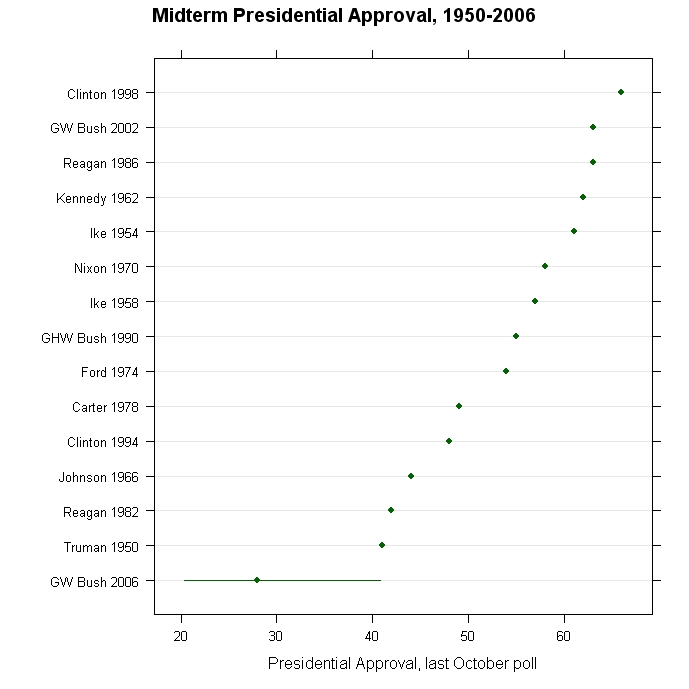
George W. Bush still has over thirty months left in office. Anything can happen in that time, of course, and few observers, if any, predicted his rapid slide in support since January 2005. But, as seen in these two charts by political scientist Charles Franklin, he is on course to be the least popular president facing a midterm congressional election since 1950. If the Democrats take the House and Senate and begin investigations, much more information about the president, vice president, and defense secretary (who was publically challenged on May 4 by the man who briefed President George H.W. Bush daily) will come to light. If a Democratic House brought impeachment charges against Bush in 2007 or 2008, would he resign?

Thursday, May 04, 2006
Footloose and (Not So) Fancy Free
"Chapman University in Orange County is home to the 'Shirtless Guy,' who wears nothing above the waist except sunglasses and black paint on his nipples.
"In the 1990s, the 'Naked Guy,' a student who created quite a stir by baring all at UC Berkeley, was expelled."
The Los Angeles Times boldly investigates the long-standing epidemic of bare feet at the California Institute of Technology.
Postscript: Sad news as the San Francisco Chronicle reports the death of Andrew Martinez, UC Berkeley's famous "Naked Guy" from the early 1990s, in an apparent suicide.
In December, The New York Times includes Martinez in its Sunday Magazine "The Lives They Led" year-end feature.
"In the 1990s, the 'Naked Guy,' a student who created quite a stir by baring all at UC Berkeley, was expelled."
The Los Angeles Times boldly investigates the long-standing epidemic of bare feet at the California Institute of Technology.
Postscript: Sad news as the San Francisco Chronicle reports the death of Andrew Martinez, UC Berkeley's famous "Naked Guy" from the early 1990s, in an apparent suicide.
In December, The New York Times includes Martinez in its Sunday Magazine "The Lives They Led" year-end feature.
Wednesday, May 03, 2006
Off the Pitch
"Iran needs to understand the consequences associated with its headlong push towards developing nuclear weapons. The foreign policy community has expressed a preference for sanctions which punish the Iranian regime and not the Iranian people. That may not be entirely possible, but no Iranian will be wanting for medicine or food if the national soccer team is prevented from competing in the World Cup. The world should use this opportunity to force a choice: either continue to provoke the world or join us in our international pastime. But not both."
Mike McGavick, Republican candidate for Sentate from Washington state, issues a modest proposal on weeklystandard.com.
Mike McGavick, Republican candidate for Sentate from Washington state, issues a modest proposal on weeklystandard.com.
"Empire of Water"
"Met endured that turmoil but faces even more trouble now. For reasons of pride and recent legislative prodding, the district must give current and future customers '100 percent assurance that retail-level demands can be satisfied under all foreseeable hydrologic conditions.' Shorn of jargon, that's a politically necessary promise to fill your tub, crockpot and water glass regardless of global warming, drought, the draining of the Colorado by new Arizona and Nevada boomtowns or the anticipated arrival of at least 6 million additional Southern Californians by 2025. And none of them will have a clue about the sources of their water or how water is managed—the real Chinatown-like aspect of living here."
In the Los Angeles Times Book Review, D.J. Waldie reviews Steven P. Erie's Beyond Chinatown: The Metropolitan Water District, Growth, and the Environment in Southern California.
In the Los Angeles Times Book Review, D.J. Waldie reviews Steven P. Erie's Beyond Chinatown: The Metropolitan Water District, Growth, and the Environment in Southern California.
Squares Unite
"But despite all that, there is apparently no room for me in the Democratic Party. In fact, I have spent much of the past week on a forced march to the G.O.P. And the bayonet at my back isn't in the hands of the Republicans; the Democrats are the bullyboys. Such lions of the left as Barbara Ehrenreich, the writers at Salon and much of the Upper West Side of Manhattan have made it abundantly clear to me that I ought to start packing my bags. I'm not leaving, but sometimes I wonder: When did I sign up to be the beaten wife of the Democratic Party?"
In Time, Caitlin Flanagan responds to her critics.
In Time, Caitlin Flanagan responds to her critics.
Tuesday, May 02, 2006
"A Pioneer of the Information Age"
"Combining two complex fields, computer programming and intricate cataloging practices, she and a small team completed the MARC Pilot Project—for Machine Readable Cataloging—in 1968. The system quickly became the preferred format for libraries throughout the country and, ultimately, around the globe."
The Los Angeles Times reports the death of Henriette D. Avram, the creator of the automated library catalog.
The Los Angeles Times reports the death of Henriette D. Avram, the creator of the automated library catalog.
Soulless Cultural Wasteland 'On the Grow' in Southern California Desert
"Thanks to its policy of draining every conceivable water source within hundreds of miles via a massive network of pipes, as well as the Chamber of Commerce's approval of the more tourist-friendly 'Los Angeles,' the up-and-coming wasteland shows every sign of ballooning into a full-scale dystopia."
From The Onion, May 1937.
From The Onion, May 1937.
Most US Young People Can't Find Iraq on Map
"Most American young people can't find Iraq on a map, even though U.S. troops have been there for more than three years, according to a new geographic literacy study released on Tuesday.
"Fewer than 4 in 10 Americans aged 18-24 in a survey could place Iraq on an unlabeled map of the Middle East, a study conducted for National Geographic found."
Not from The Onion.
"Fewer than 4 in 10 Americans aged 18-24 in a survey could place Iraq on an unlabeled map of the Middle East, a study conducted for National Geographic found."
Not from The Onion.
Monday, May 01, 2006
Left Behind
"Professor Brennan is right that the academic left is nowhere today. It matters more to David Horowitz than to anyone else. The reason is that its faith-based politics has crashed and burned. It specializes in detraction. It offers no plausible picture of the world. Such spontaneous movements as do crop up in America—like the current immigrant demonstrations—do not emerge from the campus left. Neither do reformers' intermittent attempts to eject the party of plutocracy and fundamentalism from power, to win universal health care, to protect the planet from further convulsions, to enlarge the rights of the least privileged. If more academics deigned to work toward reforms, they might contribute ideas about taxes, education, trade, employment, investment, foreign policy, and security from jihadists. But the academic left is too busy guarding the flame of nullification. They think they can fortify themselves with vigilance. In truth, their curses are gestures of helplessness."
In The Chronicle of Higher Education, Todd Gitlin reviews Eric Lott's The Disappearing Liberal Intellectual, David Horowitz's The Professors, and Timothy Brennan's Wars of Position.
In The Chronicle of Higher Education, Todd Gitlin reviews Eric Lott's The Disappearing Liberal Intellectual, David Horowitz's The Professors, and Timothy Brennan's Wars of Position.
Saturday, April 29, 2006
Democracy and Opportunity
"The A.D.A.'s most important intellectual—its equivalent of James Burnham—was the tall, German-American theologian Reinhold Niebuhr. Niebuhr was a dedicated opponent of communism, but he was concerned that in pursuing a just cause, Americans would lose sight of their own capacity for injustice. 'We must take, and must continue to take, morally hazardous actions to preserve our civilization,' he wrote. 'We must exercise our power. But we ought neither to believe that a nation is capable of perfect disinterestedness in its exercise nor become complacent about particular degrees of interest and passion which corrupt the justice by which the exercise of power is legitimized.' Americans, Niebuhr argued, should not emulate the absolute self-confidence of their enemies. They should not pretend that a country that countenanced McCarthyism and segregation was morally pure. Rather, they should cultivate enough self-doubt to ensure that unlike the Communists', their idealism never degenerated into fanaticism. Open-mindedness, he argued, is not 'a virtue of people who don't believe anything. It is a virtue of people who know. . .that their beliefs are not absolutely true.'"
The New York Times Magazine excerpts Peter Beinart's new book, The Good Fight.
U.S. News & World Report offers a Beinart profile.
"When it comes to foreign policy, the fundamental divide in American politics today is not between left and right but between those who subscribe to the myth of the 'American Century' and those who do not. Peter Beinart is a true believer."
In The Nation, Andrew J. Bacevich gives Beinart a negative review.
Jacob Heilbrunn calls Beinart a Neoconservative Democrat in the Los Angeles Times.
And Beinart and Michael Tomasky go toe-to-toe in Slate.
The New York Times Magazine excerpts Peter Beinart's new book, The Good Fight.
U.S. News & World Report offers a Beinart profile.
"When it comes to foreign policy, the fundamental divide in American politics today is not between left and right but between those who subscribe to the myth of the 'American Century' and those who do not. Peter Beinart is a true believer."
In The Nation, Andrew J. Bacevich gives Beinart a negative review.
Jacob Heilbrunn calls Beinart a Neoconservative Democrat in the Los Angeles Times.
And Beinart and Michael Tomasky go toe-to-toe in Slate.
John Kenneth Galbraith, 1908-2006
The Associated Press reports the death of America's most prominent liberal economist.
John Nichols provides an appreciation in The Nation.
In Foreign Affairs, J. Bradford DeLong argues in a review of a biography by Richard Baker that Galbraith has little contemporary influence.
But in The Nation, Eric Alterman links Galbraith with Rabbi Arthur Hertzberg and the Rev. William Sloane Coffin.
And John F. Harris in The Washington Post explores the friendship of Harvard faculty and Kennedy administration members Galbraith and Arthur M. Schlesinger, Jr.
John Nichols provides an appreciation in The Nation.
In Foreign Affairs, J. Bradford DeLong argues in a review of a biography by Richard Baker that Galbraith has little contemporary influence.
But in The Nation, Eric Alterman links Galbraith with Rabbi Arthur Hertzberg and the Rev. William Sloane Coffin.
And John F. Harris in The Washington Post explores the friendship of Harvard faculty and Kennedy administration members Galbraith and Arthur M. Schlesinger, Jr.
Friday, April 28, 2006
Had Enough?
"In 1946, Karl Frost, an advertising executive, suggested a simple slogan to the Massachusetts Republican Committee: 'Had Enough? Vote Republican!' Frost recognized that these simple words could unite his national party and blame its opponents, who controlled Congress, for causing or failing to solve the many problems facing the country, including meat shortages, economic difficulties and labor unrest. The strategy worked: in 1946, both houses of Congress flipped.
"Sixty years later, Democrats would be smart to turn Karl Frost's slogan on Karl Rove's strategy."
In The New York Times, Tim Roemer revives a famous rallying cry.
"Sixty years later, Democrats would be smart to turn Karl Frost's slogan on Karl Rove's strategy."
In The New York Times, Tim Roemer revives a famous rallying cry.
The End of Multiculturalism?
"While Phillips has drawn the ire of the far left, he has found support among his center-left Labor Party colleagues. Like Phillips, Sunder Katwala, the general secretary of the Fabian Society, a Labor-aligned think tank, believes that pluralism is inherent in the concept of Britishness, and so why not foster Britishness rather than its constituent parts? A self-described 'mongrel Brit' and 'product of the rise and fall of the British Empire,' Katwala, the 32-year-old whiz-kid son of an Indian father and an Irish mother, argues that for a generation the 'politics of recognition' have overshadowed liberals' traditional concern with equality.
"'We need to create a progressive notion of integration and make it compatible with our goal of equality,' he said."
Gregory Rodriguez in the Los Angeles Times discusses a shift in emphasis in Britain away from diversity and toward unity.
"'We need to create a progressive notion of integration and make it compatible with our goal of equality,' he said."
Gregory Rodriguez in the Los Angeles Times discusses a shift in emphasis in Britain away from diversity and toward unity.
So Sorry
"'The comment was not meant to be a regional slur. To the extent that it was misinterpreted to be one, I apologize.'
—Lawyer Kenneth Taylor, after referring to people living in the mountains of Kentucky as 'illiterate cave dwellers.' Oct. 17, 2003"
In the Los Angeles Times, Paul Slansky and Arleen Sorkin catalogue various apologies.
—Lawyer Kenneth Taylor, after referring to people living in the mountains of Kentucky as 'illiterate cave dwellers.' Oct. 17, 2003"
In the Los Angeles Times, Paul Slansky and Arleen Sorkin catalogue various apologies.
Wednesday, April 26, 2006
What's the Matter with Politics?
"Harry Truman was no centrist, and neither was he a radical. Still, listening to his ferocious ad-libs back in 1948 (which was, incidentally, not during the Great Depression), his audience could have had few doubts about what the Democratic Party stood for. Truman was explicit: '[T]he Democratic Party is the people’s party, and the Republican Party is the party of special interest, and it always has been and always will be.' He reveled in what Mr. Klein would call 'class war,' calling a Republican tax cut a 'rich man’s tax bill' that 'helps the rich and sticks a knife into the back of the poor' and describing politics as a contest between the 'common everyday man' and the 'favored classes,' the 'privileged few.' Even more astonishingly, Truman went on to talk policy in some detail, with special emphasis on Mr. Klein’s hated 'jobs, health-care, and blah-blah-blah': He called for the construction of public housing, an increase in the minimum wage, expansion of Social Security, a national health-care program and the repeal of the Taft-Hartley Act. And this sort of high-octane oratory propelled Truman on to win the election in a historic upset."
Thomas Frank reviews Joe Klein's Politics Lost in The New York Observer.
Thomas Frank reviews Joe Klein's Politics Lost in The New York Observer.
Tuesday, April 25, 2006
Scholars Discover 23 Blank Pages That May As Well Be Lost Samuel Beckett Play
"Enthusiasts still maintain that the 'nuances, subtleties, and allusions to his previous works' are all unmistakably Beckett. They also claim to have found notes and ideas for this play in the margins of Beckett's earlier works."
From The Onion.
From The Onion.
Jane Jacobs, 1916-2006
Reuters reports the death of Jane Jacobs, author of 1961's influential urban-planning critique The Death of Life of Great American Cities.
Appreciations come in from Christopher Hawthorne in the Los Angeles Times and Witold Rybczynski in Slate.
"The answer to such superficiality is not to resurrect the spirit of Robert Moses. But in retrospect his vision, however flawed, represented an America that still believed a healthy government would provide the infrastructure—roads, parks, bridges—that binds us into a nation. Ms. Jacobs, at her best, was fighting to preserve the more delicate bonds that tie us to a community. A city, to survive and flourish, needs both perspectives."
Nicolai Ouroussoff offers a counterpoint in The New York Times.
Appreciations come in from Christopher Hawthorne in the Los Angeles Times and Witold Rybczynski in Slate.
"The answer to such superficiality is not to resurrect the spirit of Robert Moses. But in retrospect his vision, however flawed, represented an America that still believed a healthy government would provide the infrastructure—roads, parks, bridges—that binds us into a nation. Ms. Jacobs, at her best, was fighting to preserve the more delicate bonds that tie us to a community. A city, to survive and flourish, needs both perspectives."
Nicolai Ouroussoff offers a counterpoint in The New York Times.
Monday, April 24, 2006
Big Revival in Little Tokyo
"Though few outside Pentecostalism know of him, Pastor Seymour, a son of slaves from Louisiana, held round-the-clock religious revivals that drew thousands of people of all races to the Azusa Street Mission.
"His ministry began at a prayer meeting on April 9, 1906, at 216 N. Bonnie Brae St., when it was 'visited by a move of the Holy Spirit' and people began to speak and sing in tongues....
"Within days, his flock had grown so large that he had to find a bigger place — an abandoned building at 312 Azusa St...."
The Los Angeles Times notes the beginning of this week's centennial celebration in downtown L.A. of the birth of Pentecostalism.
"The revival celebration means a lot to Los Angeles, Butler said. 'In many ways, L.A. is always associated with the movie and entertainment industry,' she said. 'But when you think about the City of the Angels, the spiritual focus of the city from the very beginning was always part of the life blood of Los Angeles — life blood that was really ignored in light of the entertainment industry here.'"
More from the Times.
"His ministry began at a prayer meeting on April 9, 1906, at 216 N. Bonnie Brae St., when it was 'visited by a move of the Holy Spirit' and people began to speak and sing in tongues....
"Within days, his flock had grown so large that he had to find a bigger place — an abandoned building at 312 Azusa St...."
The Los Angeles Times notes the beginning of this week's centennial celebration in downtown L.A. of the birth of Pentecostalism.
"The revival celebration means a lot to Los Angeles, Butler said. 'In many ways, L.A. is always associated with the movie and entertainment industry,' she said. 'But when you think about the City of the Angels, the spiritual focus of the city from the very beginning was always part of the life blood of Los Angeles — life blood that was really ignored in light of the entertainment industry here.'"
More from the Times.
Sunday, April 23, 2006
Downtown Orange County?
"Author Joel Kotkin, a national expert on urban growth who is based in Costa Mesa, said he finds the slogan puzzling: 'I don't quite get it. One of the unique things about Orange County is it really doesn't have a downtown. It has several downtowns.'"
The Los Angeles Times reveals Santa Ana's new city slogan.
The Los Angeles Times reveals Santa Ana's new city slogan.
"A Contemplative in Action"
"And the journey is not over. A former governor and son of a former governor, a repeat presidential candidate, a loser for the U.S. Senate, an urban mayor, the brother of a state treasurer who was herself a candidate for governor, Brown is now running for attorney general—the state's top law enforcement office and, also, a position once held by his father. At 68, he's on the stump in what appears to be high spirits, talking tough about crime, the environment and worker rights, but also having fun coloring outside the lines."
The Los Angeles Times checks in with Oakland mayor Jerry Brown ahead of the June California Democratic primary race for state attorney general.
The Los Angeles Times checks in with Oakland mayor Jerry Brown ahead of the June California Democratic primary race for state attorney general.
Get Your Yeah-Yeahs Out
"Back at the video shoot at the Los Angeles slaughterhouse, there was a surreal moment when an unexpected visitor wandered onto the set. It was Los Angeles Sheriff Lee Baca, the leader of the largest police force in the country, who looked a bit ashen when he happened upon a scenario that looked like some sort of fast-food snuff film. He had been touring the property for a completely unrelated purpose and, as he exited, he made a strained joke about wanting to go on a diet after seeing the surreal proceedings.
Coyne wore a smile of puerile mischief as he watched Baca leave. 'If he saw the cops in the video he might have gotten mad,' Coyne said. 'That could be fun.'"
Ladies and gentlemen, the Los Angeles Times presents a profile of the Flaming Lips.
Coyne wore a smile of puerile mischief as he watched Baca leave. 'If he saw the cops in the video he might have gotten mad,' Coyne said. 'That could be fun.'"
Ladies and gentlemen, the Los Angeles Times presents a profile of the Flaming Lips.
"The Monstrous and the Mundane"
"During the Cold War, Arendt's theories provided both comfort and powerful propaganda for conservatives in the West by suggesting that there was no difference between the Third Reich and the Soviet system—Eichmanns flourished under both. For the left, Arendt's 'banality of evil' model seemed to explain how government bureaucrats could operate weapons of mass destruction against civilians and how military men such as Army Lt. William Calley could follow orders and commit atrocities in Vietnam."
In the Los Angeles Times, David Cesarani of the University of London challenges the legacy of Adolf Eichmann's trial, which began forty-five years ago this month.
In the Los Angeles Times, David Cesarani of the University of London challenges the legacy of Adolf Eichmann's trial, which began forty-five years ago this month.
Wednesday, April 19, 2006
Democrats Must Become republicans
"The old liberalism got America out of depression, won the war against fascism, built the middle class, created global alliances, and made education and health care far closer to universal than they had ever been. But there were things it did not do; its conception of the common good was narrow--completely unacceptable, in fact, to us today. Japanese Americans during World War II and African Americans pretty much ever were not part of that common good; women were only partially included. Because of lack of leadership and political expediency (Roosevelt needing the South, for example), this liberalism had betrayed liberal principle and failed millions of Americans. Something had to give.
"At first, some Democrats--Johnson and Humphrey, for example, and even some Republicans back then--tried to expand the American community to include those who had been left behind. But the political process takes time, and compromise; young people and black people and poor people were impatient, and who could blame them? By 1965, ’66, ’67, the old liberalism’s failures, both domestically and in Vietnam, were so apparent as to be crushing. A new generation exposed this 'common good' as nothing more than a lie to keep power functioning, so as not to disturb the 'comfortable, smooth, reasonable, democratic unfreedom' that Herbert Marcuse described in 1964 in one of the more memorable phrases of the day. Activists at the time were convinced--and they were not particularly wrong--that the old liberalism, far from nurturing a civic sphere in which all could deliberate and whose bounty all could enjoy, had created this unfreedom. The only response was to shatter it."
In an important article in The American Prospect, Michael Tomasky diagnoses the problem and offers a prescription.
"So would liberals be willing to go whole hog? At the very least, they'd probably be willing to embrace common-good type appeals when it comes to economics--things like healthcare and the minimum wage. They'd probably also unite behind a common-good approach to certain social issues like immigration and affirmative action (e.g., the argument that we all benefit from immigration, not just immigrants), both of which Tomasky discusses. In each of these cases, the challenge is to rethink the rationale behind policies liberals already support, not to rethink the policies themselves. But what about stickier social issues, where a common-good approach might lead you in a substantively different direction? (To say nothing about foreign policy, which is an entirely separate can of worms.) Would liberals get on board with that? My hunch is no."
In The New Republic, Noam Scheiber points to problems for the Democrats in emphasizing communitarianism over libertarianism.
"At first, some Democrats--Johnson and Humphrey, for example, and even some Republicans back then--tried to expand the American community to include those who had been left behind. But the political process takes time, and compromise; young people and black people and poor people were impatient, and who could blame them? By 1965, ’66, ’67, the old liberalism’s failures, both domestically and in Vietnam, were so apparent as to be crushing. A new generation exposed this 'common good' as nothing more than a lie to keep power functioning, so as not to disturb the 'comfortable, smooth, reasonable, democratic unfreedom' that Herbert Marcuse described in 1964 in one of the more memorable phrases of the day. Activists at the time were convinced--and they were not particularly wrong--that the old liberalism, far from nurturing a civic sphere in which all could deliberate and whose bounty all could enjoy, had created this unfreedom. The only response was to shatter it."
In an important article in The American Prospect, Michael Tomasky diagnoses the problem and offers a prescription.
"So would liberals be willing to go whole hog? At the very least, they'd probably be willing to embrace common-good type appeals when it comes to economics--things like healthcare and the minimum wage. They'd probably also unite behind a common-good approach to certain social issues like immigration and affirmative action (e.g., the argument that we all benefit from immigration, not just immigrants), both of which Tomasky discusses. In each of these cases, the challenge is to rethink the rationale behind policies liberals already support, not to rethink the policies themselves. But what about stickier social issues, where a common-good approach might lead you in a substantively different direction? (To say nothing about foreign policy, which is an entirely separate can of worms.) Would liberals get on board with that? My hunch is no."
In The New Republic, Noam Scheiber points to problems for the Democrats in emphasizing communitarianism over libertarianism.
Monday, April 17, 2006
Undead, Undead, Undead
"The Scottish team described Goths as being a subgenre of Punk 'with a dark and sinister aesthetic, with aficionados conspicuous by their range of distinctive clothing and makeup and tastes in music.'"
Reuters reports a new study, published in the British Medical Journal, by researchers at Glasgow University who argue that Goths are more likely to harm themselves or attempt suicide.
Reuters reports a new study, published in the British Medical Journal, by researchers at Glasgow University who argue that Goths are more likely to harm themselves or attempt suicide.
Inventing the Prize
The Pulitzer Board announces the winners of the 2006 Pulitzer Prizes, including David M. Oshinsky for history, Kai Bird and Martin J. Sherwin for biography, and special citations for Thelonious Monk and Edmund S. Morgan.
This Is the City...
"Today, as that recent roll call suggests, the 9,314-officer LAPD is a different place. Like the city, it is less than half white; one in five officers is a woman, and Hispanics make up roughly a third of the department, with their representation even greater in the lower ranks, reflecting more recent hiring.
"'Fifteen years ago, this department was dominated by white males,' Mack said. 'That picture clearly has changed dramatically.'"
The Los Angeles Times reports the shifting demographics of the Los Angeles Police Department.
And the Times runs an obit for Chief Ed Davis, who led the LAPD from 1969 to 1978, between William Parker and Daryl Gates.
"'Fifteen years ago, this department was dominated by white males,' Mack said. 'That picture clearly has changed dramatically.'"
The Los Angeles Times reports the shifting demographics of the Los Angeles Police Department.
And the Times runs an obit for Chief Ed Davis, who led the LAPD from 1969 to 1978, between William Parker and Daryl Gates.
Sunday, April 16, 2006
Eastward the Course of Empire Takes Its Way
"The region's median income now surpasses that of Los Angeles County. It is creating more jobs than Orange and San Diego counties are creating put together. Riverside and San Bernardino counties boast more residents than Oregon.
"'The L.A. dream still exists, it just moved east,' said Joel Kotkin, a senior fellow at the New America Foundation who writes frequently about California. 'Ontario is transitioning into what Los Angeles once was, with both white collar and blue collar.'"
The Los Angeles Times discusses the booming growth of southern California's Inland Empire.
"'The L.A. dream still exists, it just moved east,' said Joel Kotkin, a senior fellow at the New America Foundation who writes frequently about California. 'Ontario is transitioning into what Los Angeles once was, with both white collar and blue collar.'"
The Los Angeles Times discusses the booming growth of southern California's Inland Empire.
Thursday, April 13, 2006
Scenes from the Feminist Struggle on the Upper West Side
"For mothers who can afford full-time baby nurses and $20,000-a-year private schools? Who would no sooner partake of universal day care ('Women, unite! Universal day care!') than they would of their corner brown-skinned public elementary, where their nanny's children go? I don't think so. (Wealthy, powerful left-leaning women will never be able to admit that they have much more in common with wealthy, powerful men than they do with their poor, disenfranchised pseudo-sisters.) I do, however, like Cheever's notion that 'working and stay-at-home moms today are like the famous psychology experiment in which too many rats are put in a cage with too little food.' Although I think the cage is the three square miles around 76th and Broadway, and the problem is too much food (if not actually Barney Greengrass eastern Gaspé smoked salmon)."
In The Atlantic, Sandra Tsing Loh reviews Mommy Wars, edited by Leslie Morgan Steiner.
In The Atlantic, Sandra Tsing Loh reviews Mommy Wars, edited by Leslie Morgan Steiner.
"A Flood of Noise and Sound"
From "Canzone del Porter" to "Teen Age Riot," the Library of Congress unveils the latest additions to the National Recording Registry.
The Heart Is a Little to the Left
"For his ruggedly handsome, engagingly flawed, humane if not always lawful behavior, he inspired the Doonesbury comic strip character, the Rev. Scot Sloan. In the late 1960s, after the most heated battles of the desegregation movement had passed, U.S. involvement in Vietnam escalated and Coffin took on the war as his issue. While his colleagues at Yale had supported him through the civil rights era, his popularity there waned during the Vietnam conflict."
The Los Angeles Times explores the life of the Rev. William Sloane Coffin, Jr., who died yesterday at age 81.
Slate runs an appreciation by Mark Oppenheimer.
The Los Angeles Times explores the life of the Rev. William Sloane Coffin, Jr., who died yesterday at age 81.
Slate runs an appreciation by Mark Oppenheimer.
Wednesday, April 12, 2006
Curiouser and Curiouser
The Los Angeles Times runs an obit for Swedish director and Ingmar Bergman-protege Vilgot Sjoman, who made 1967's I Am Curious (Yellow), the movie that successfully challenged American obscenity laws.
The American Religious Tradition
"The book described nearly every denomination and the people who made them tick: Protestant groups from Anglican to Pentecostal, Catholicism, Judaism, Hinduism, Buddhism, neo-pagan groups and atheist associations, along with bibliographical references and mailing addresses.
'I quickly arranged to review it for a journal and then contacted Gordon, expecting to meet a frail guy of 80 who'd spent his entire life putting it together,' Stark said. 'Instead, he turned out to be this young Methodist preacher who'd done the whole thing in his attic.'"
Louis Sahagun in the Los Angeles Times profiles UC Santa Barbara's J. Gordon Melton, who wrote 1979's Encyclopedia of American Religions.
And by way of Ghost in the Machine, Regions of Mind weblog reprints maps depicting American religious identity, created by Glenmary Research Center.
'I quickly arranged to review it for a journal and then contacted Gordon, expecting to meet a frail guy of 80 who'd spent his entire life putting it together,' Stark said. 'Instead, he turned out to be this young Methodist preacher who'd done the whole thing in his attic.'"
Louis Sahagun in the Los Angeles Times profiles UC Santa Barbara's J. Gordon Melton, who wrote 1979's Encyclopedia of American Religions.
And by way of Ghost in the Machine, Regions of Mind weblog reprints maps depicting American religious identity, created by Glenmary Research Center.
Popular or Professional?
"Unfortunately, Hoffer's rendering of the profession, dividing it between the older historians who relied on 'comforting falsehoods' and his own generation which emphasized discomforting truths, is indicative of the impasse in contemporary historical scholarship to which Wood refers. Perhaps the solution is not for professional historical societies to gain more courage in extending their outrage over oppression and injustice to professional malfeasance. The way forward may be for historians to admit that the failings of America are just as complicated and deserve as much nuance as the nation's accomplishments. And to deflate the self-righteousness that afflicts the profession, the leaders of the OAH might reconsider the priorities that led them to move their convention to San Jose."
In Christianity Today, D. G. Hart reviews Peter Charles Hoffer's Past Imperfect.
In Christianity Today, D. G. Hart reviews Peter Charles Hoffer's Past Imperfect.
Tuesday, April 11, 2006
Rhinestone Cowgirl
The Los Angeles Times reports the death of Helen B. Cohn, "Bobbie Nudie," who with her late husband, Nudie Cohn, opened Nudie's Rodeo Tailors in 1947 and went on to clothe Hank Williams, Elvis Presley, Gram Parsons, and Johnny Cash.
Monday, April 10, 2006
Understanding the Poetics of Space
"'It suggests that the compass has rotated somewhere' away from Western Europe and the U.S., he said. 'Here's this old-fashioned model of someone like Gaudí, who barely set foot outside Barcelona. It stretches the world's frame of reference: He hasn't had to move physically to move the world internationally.'"
Scott Timberg in the Los Angeles Times profiles Paulo Mendes da Rocha, winner of the 2006 Pritzker Architecture Prize.
Scott Timberg in the Los Angeles Times profiles Paulo Mendes da Rocha, winner of the 2006 Pritzker Architecture Prize.
Sunday, April 09, 2006
Current Affairs
In the April 9 Los Angeles Times opinion pages, Todd Gitlin criticizes political sectarianism, Francis Fukuyama defends changing one's mind, Swati Pandey lists five political side-switchers, Charles Murray resurrects Richard Nixon's guaranteed annual income, and Jonathan Chait proposes an end-run around the electoral college.
Les Enfants du Lumieres
"The French are terrific at carrying off romantic gallantry but equally unsparing at laying bare the nastiness, the dankness and pure evil that can consume the human spirit. While French cinema is hardly free of mediocre movies, it has been sustained, like that of the Japanese, by a continual flow of gifted filmmakers grappling honestly with the human experience. At their best, French movies, past and present, remain essential viewing."
Kevin Thomas in the Los Angeles Times presents a brief history of French cinema, including a list of important films on DVD.
Kevin Thomas in the Los Angeles Times presents a brief history of French cinema, including a list of important films on DVD.
Saturday, April 08, 2006
This Is My Happening and It Freaks Me Out
The Los Angeles Times runs an obit for artist Allan Kaprow, the pioneer of "happenings."
Friday, April 07, 2006
Round Up the Usual Suspects
The Writers Guild of America announces the results of its members' poll of the 101 greatest screenplays.
La Bataille Continue...
"The plaque explained that the students created the phony 'Howe & Ser Moving Company' and used fake work-order forms to get past Caltech campus security guards. After that, a real shipping company toted the 2-ton relic across the country."
The Los Angeles Times reports the theft of the cherished Fleming Cannon from the hallowed campus of the California Institute of Technology.
Update: Caltech students reclaim the cannon.
But The Onion notes new problems for MIT.
The Los Angeles Times reports the theft of the cherished Fleming Cannon from the hallowed campus of the California Institute of Technology.
Update: Caltech students reclaim the cannon.
But The Onion notes new problems for MIT.
Thursday, April 06, 2006
We're Gonna Need a Bigger Bomb
The Telegraph reports the death at 92 of Nina Countess Schenk von Stauffenberg, wife of Claus Schenk von Stauffenberg, the German colonel who unsuccessfully tried to assassinate Hitler in 1944.
Wednesday, April 05, 2006
Not a Rebel to Me
Singer Gene Pitney, the writer of Phil Spector's greatest production, "He's a Rebel," dies at 65.
Tuesday, April 04, 2006
Water and Power
"In his 1970 book 'The Architecture of Four Ecologies,' architecture critic Reyner Banham glowingly called it 'the only public building in the whole city that genuinely graces the scene, lifts the spirit and sits in firm control of the whole basis of human existence in Los Angeles.'"
The Los Angeles Times reports the death of architect Albert C. Martin, Jr., who designed the Los Angeles Department of Water and Power building in 1965.
Scott Timberg adds an analysis in the Los Angeles Times.
The Los Angeles Times reports the death of architect Albert C. Martin, Jr., who designed the Los Angeles Department of Water and Power building in 1965.

Scott Timberg adds an analysis in the Los Angeles Times.
Sunday, April 02, 2006
Observation or Celebration?
"Newsom acknowledged that the 1906 earthquake was an awkward' event to mark.
"'Do you sit there with a candlelight vigil and say, "My God, how dare the city do what it did back then, with the corruption of city officials or the mistreatment of its Chinese American residents?"' he said.
"'Do you sit there and tell people, "Why are we all here? The next earthquake is going to come, and most of us are not going to make it." Or do you focus on the city's comeback and rebuilding?'"
The Los Angeles Times discusses the difficulties San Francisco has had in commemorating the centennial of the 1906 earthquake and fire.
"'Do you sit there with a candlelight vigil and say, "My God, how dare the city do what it did back then, with the corruption of city officials or the mistreatment of its Chinese American residents?"' he said.
"'Do you sit there and tell people, "Why are we all here? The next earthquake is going to come, and most of us are not going to make it." Or do you focus on the city's comeback and rebuilding?'"
The Los Angeles Times discusses the difficulties San Francisco has had in commemorating the centennial of the 1906 earthquake and fire.
Manliness and Civilization
"First of all, he thinks we should clearly distinguish between the public realm and private life. In public we should pursue, as best we can, a policy of gender neutrality. He firmly believes that the law should guarantee equal opportunity to men and women. However, 'our expectations should be that men will grasp the opportunity more readily and more wholeheartedly than women.'"
Christina Hoff Summers reviews Harvey C. Mansfield's Manliness in The Weekly Standard.
Christina Hoff Summers reviews Harvey C. Mansfield's Manliness in The Weekly Standard.
Saturday, April 01, 2006
All the Rest Is Commentary
"Turbulent times accompanied the birth of Hinduism and Buddhism in India, Confucianism and Taoism in China, monotheism in the Middle East and rationalism in Greece.
"All shared a core vision for building a better world that was both simple and drastic: Do not harm others."
The Los Angeles Times interviews Karen Armstrong about the Golden Rule.
"All shared a core vision for building a better world that was both simple and drastic: Do not harm others."
The Los Angeles Times interviews Karen Armstrong about the Golden Rule.
Subscribe to:
Posts (Atom)